Showing posts with label TECHNOLOGY. Show all posts

 According to the NetBlocks Cost of Shutdown Tool, the blockade costs Nigeria’s economy N103.17m ($250,600) every hour.


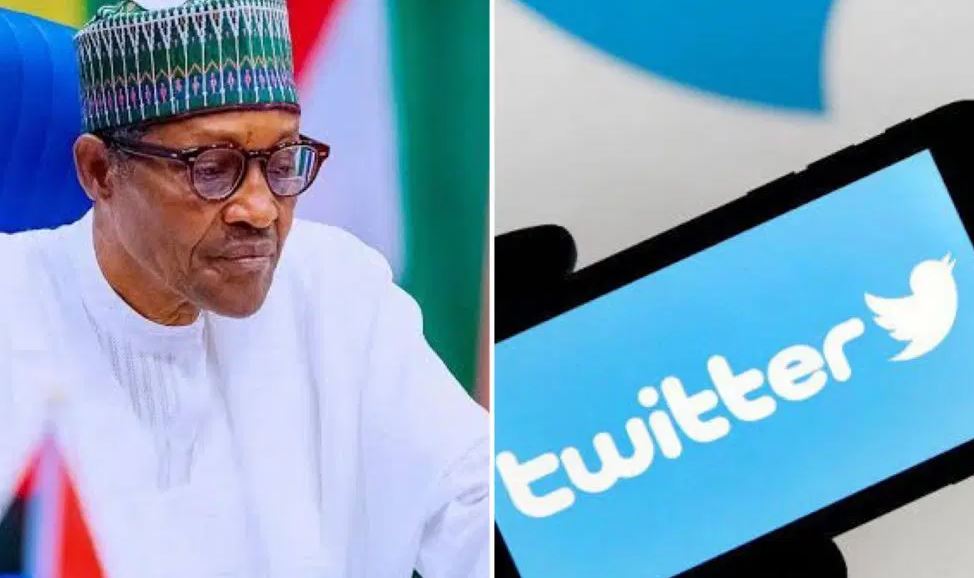
Buhari

Nigeria Loses N247.61billion In 100 Days

Following the suspension of micro-blogging site, Twitter, Nigeria has reportedly lost N247.61billion.

The Federal Government had on June 4 suspended Twitter after the social media platform deleted a tweet by the President Muhammadu Buhari

Consequently, telcos on June 5 blocked access to Twitter after receiving a directive by the Nigerian Communications Commission.

On this, the Association of Licensed Telecommunications Operators of Nigeria had said, “We, The Association of Licensed Telecommunication Operators of Nigeria wish to confirm that our members have received formal instructions from the Nigerian Communications Commission, the industry regulator, to suspend access to Twitter.

“ALTON has conducted a robust assessment of the directive in accordance with internationally accepted principles.”


According to the NetBlocks Cost of Shutdown Tool, the blockade costs Nigeria’s economy N103.17m ($250,600) every hour, The Punch reports

It has been 2,400 hours since the FG banned Twitter.

Recently, the Presidency through the Minister of Information and Culture, Alhaji Lai Mohammed, said it was close to an agreement with Twitter and would soon lift the ban.

Nigeria is a member of an exclusive list of countries such as China, Iran, and North Korea where Twitter is banned. Since the ban, the use of Virtual Private Networks has risen.

A firm, ExpressVPN had said that it recorded an increase of over 200 per cent in web traffic from Nigeria since the Federal Government banned microblogging site.


Mohammed had travelled to meet with top executives of popular microblogging site, Twitter following the suspension of the app in Nigeria.

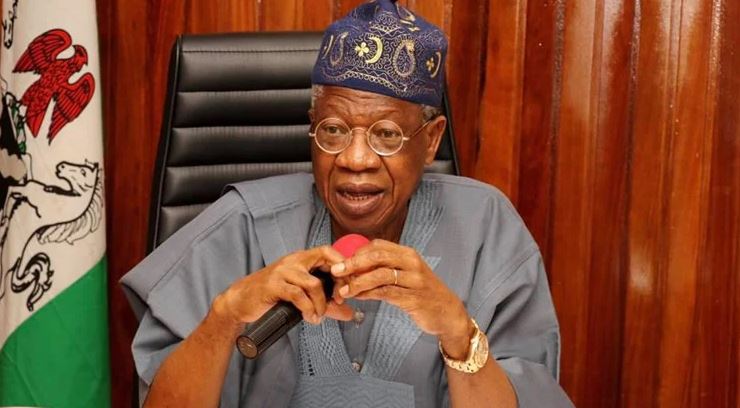
Lai Mohammed
Lai Mohammed
 
After a fruitless journey in the United States, Nigeria's Minister of Information and Culture, Lai Mohammed has returned to the country, according to Sahara Reporters.
 
Mohammed had travelled to meet with top executives of popular microblogging site, Twitter following the suspension of the app in Nigeria by the President Muhammadu Buhari-led government in June. 
 
However, a top source disclosed to SaharaReporters that the trip was a futile one for the minister as he could not meet with Twitter executives and was also shunned by American media. 
 
SaharaReporters last Tuesday exclusively obtained a video showing the minister and Olusegun Adeyemi, Special Assistant to the President (Media), Office of the Minister of Information and Culture, in a Delta Airline heading to the US.
 
"Lai Mohammed and his PA are returning to Nigeria after failed attempt to meeet Twitter excos and also the American media he claimed he wanted to meet in Washington, D.C. shunned him," the source said about their trip to the US. 
 
Meanwhile, this newspaper has again obtained the flight details of the duo on Delta Airline to Nigeria. 
 
Information available to SaharaReporters shows Mohammed and Adeyemi are flying First Class, with departure time from JFK (John F. Kennedy International Airport, New York) to LOS (Lagos) stated as 9.33pm, though delayed. 
 
At the JFK, the duo will use Gate B38 at Terminal 4 while their arrival time is 12.58pm, though also delayed. 
 
For their arrival at the Murtala Muhammed International Airport, Lagos, the duo will make use of Gate D44.
 
The total flight time is stated as 14 hours, 15 minutes. 
 
The Buhari-led government on June 5, 2021 indefinitely banned Twitter, restricting it from operating in Nigeria after the social media platform deleted tweets posted by Buhari. 
 
Buhari's tweets, which many Nigerians found distasteful, had warned the Southeastern people of Nigeria against secession agenda, threatening to deal with them "in the language they understand". His comments referenced the Nigeria Civil War (1967-1970) in which an estimated 2 million South-Easterners died of starvation. 
 
However, the Nigerian government claimed the ban was ultimately based on "a litany of problems with the social media platform in Nigeria, where misinformation and fake news spread through it have had real world violent consequences".
 
It also accused Twitter of threatening the corporate unity of Nigeria. 
 
The ban has been condemned by Amnesty International, Swedish Embassy and the British and Canadian missions in Nigeria. 
 
Domestic organisations including the Socio-Economic Rights and Accountability Project (SERAP) have challenged the ban in court. 
 
Sadly, though many Nigerians have bypassed the ban by using Virtual Private Network (VPN), the already battered economy of the country loses a fortune every day to the ban. 
 
For instance, as at August 6, British firm, Top10VPN estimated that the ban had affected around 104.4 million internet users in the country, and cost the country around $366.9 million. The firm made the calculations using a tool developed by internet governance watchdog organisation, Netblocks, and Internet Society, a US advocacy nonprofit.

 The Minister of Information and Culture, Lai Mohammed disclosed this during an interview with newsmen in Washington.


Lai

Lai Mohammed

Following the suspension of micro-blogging site, Twitter, the Federal Government  has disclosed that seven out of ten demands have been accepted by the social media site.

The Minister of Information and Culture, Lai Mohammed disclosed this during an interview with newsmen in Washington, NAN reports.

The minister also noted that there is an end in sight of an amicable settlement of the ban.

“We believe that even the other three outstanding demands are not really about whether they agreed or not but about timing and scheduling.

“That is what gave me the confidence that we are getting nearer to an agreement,
’’ he said.

The minister said, among the demands made from twitter was for the platform to register as a Nigerian company, pay taxes from revenue made from the country and ensure that harmful content are regulated.

“As recently as last week, we exchange correspondence with Twitter, and when I left home a few days ago, we are expecting a reply from them.

“It is rather, more left with Twitter to respond to grey areas that we asked them to look into.

“We are not inflexible in our negotiation with Twitter because we recognise both the positive and negative aspects of social media,’’
 he added.

He, however, said the Twitter ban had been very effective in the country because they see less harmful and injurious content on social media, adding that they had been more conscious and alert to injurious content likely to threaten national security.


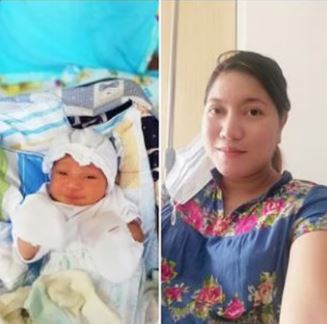
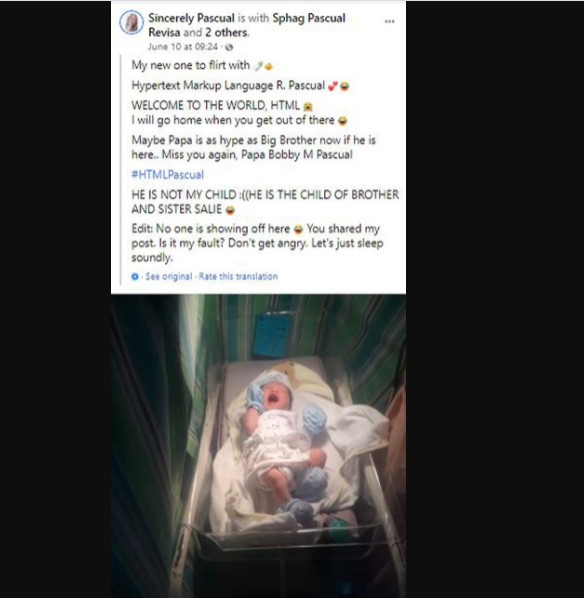
The web designer introduced his newborn baby and his name - HTML to the world on Facebook.

Newborn baby named HTML
 
A Philippines web designer has in respect for his profession, named his son HTML.
 
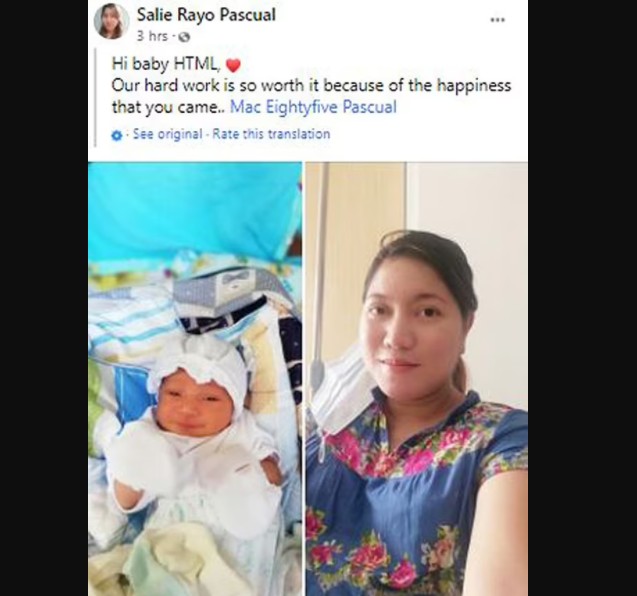
In a Facebook post, the newborn was introduced as Hypertext Mark-up Language Rayo Pascual - or HTML for short
 
The child's father Mac Pascual, a web developer, reportedly chose the unusual name as a tribute to his profession.
 
He told local news site inquirer.net that uncommon names run in his family, explaining that his own name is short for Macaroni 85.
 
He said that one of his sisters' official names was Spaghetti 88 and claimed her two children are called Cheese Pimiento and Parmesan Cheese, though they go by Chippy and Peewee for short.
 
Inquirer.net reported that HTML was born healthy, weighing 2.25 kilograms (4.9 pounds) at the Bulacan Medical Mission Group Cooperative Hospital, about an hour's drive north of the capital, Manila.
 
His mum, Salie Rayo Pascual, told the website that she is delighted to welcome her child and said relatives were pleased with the choice of name.
 
HTML's aunt, Sincerely Pascual - full name Sincerely Yours Pascual - shared a snap of the newest addition to her family on Facebook, writing: 'Welcome to the world HTML.'
 
The post has been shared more than 8,978 times and inspired numerous jokes from social media users.
 
'[That baby] will grow up to hack the Pentagon. It's in his name,' one comment reads.
 
Several users suggested some computer-based names for any future children: 'Results-based management system', 'JavaScript' or 'Cascading Style Sheets (CSS)'.
 
'In the future, he could be targeted by bullies and ridiculed,' one user wrote.
 
'Parents should be sensible and responsible in naming their child... it's child's lifetime and identity and why make her/him suffer for obvious reasons... it's not actually a human name!,' another commented.
 
A third Facebook user said: 'If I were that child, I'd sue my parents one day.'


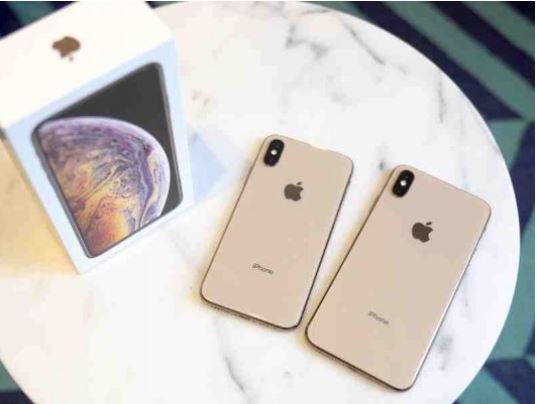
Many folks are complaining that the selfies they take with iPhone XS or iPhone XS Max, which are the new iPhones, are making them look too beautiful.
 
Obviously, there is nothing wrong with people looking very beautiful, other than the sometimes undesirable attention that beauty generates.
Moreover, a little enhancement here and there on your looks doesn’t sound much like a bad idea. However, many folks are complaining that the selfies they take with iPhone XS or iPhone XS Max, which are the new iPhones, are making them look too beautiful. People think that the camera is over-processing their faces with filters that smooth out their skins – getting rid of stuff like acne or rashes – and making their skin look clearer and nicer. How dare the iPhone make people look more attractive?
Yes, the new technologies in iPhone appear to smooth out your skin and reduce shadows and other details in photos you take with the phones’ selfie cameras. The effect is similar to the so-called “beauty mode” on some other smartphones such as Samsung and in some apps.
The difference is that, whereas you can adjust or turn on/off the beauty mode (beauty filter) in these other phones, the phenomenon observed in iPhone is automatic (hard-coded) and can’t be controlled by you. (Ironically, one of the big selling features of the new iPhone XS is the 8-megapixel front-facing camera. The front-facing camera is for the selfie, whereas the backward-facing cameras are for the regular shots.)
Apple says it does not offer the beauty filter feature in iPhones, though it seems that the effects of the new photographic techniques in iPhone are similar to those of beauty filters.
According to the company, the selfie camera system on the new iPhone uses faster sensors, improved chips and “advanced algorithms” to make your photos look better with a feature called “Smart HDR.” Some users believe Apple uses the beauty filter in its cameras’ algorithms.
Is the complaint of too much beauty an overreaction? Beauty is not supposed to be such a bad thing. However, some people want their photos to look like them, “warts and all!” Actually, it is a case of “one man’s meat being another’s poison,” as some people, particularly in Asia, actually love the beauty mode feature in smartphones such as the Samsung Galaxies. Meitu, an app from China, is advertised as the most advanced way to make your photos more beautiful, and it is loved in China. FaceTune, developed in Jerusalem, is another photo-beautifying app. These apps smooth out and brighten your skin so you look a little more polished on social media.
What does Apple say? Apple traces the problem to its aggressive effort to reduce the noise from shots taken by smartphones. A serious noise problem happens when you take photos in low light, which causes little bits of grain to appear across the photo. Noise is a particular problem with smartphone cameras because they have small lenses and sensors that are not able to allow much light in as do professional rigs. Apple’s disposition centres on producing high quality cameras by improving the system’s chips to enable noise reduction in photos.
This is what the company says it does: “We set a reference frame and fuse in information from multiple frames. As you stack the frames, if you have the same image, you have lower and lower noise and better and better detail.”
Lewis Hilsenteger of Business Insider interprets this to mean that “perhaps if a photo is taken with more light, the smoothing would appear less prominent. A test run on Thursday in natural daylight did show a less pronounced smoothing effect.”
Let’s look at the great technologies, two them, behind the cameras in iPhone XS. One is HDR, or High Dynamic Range, which is a photographic technique for dealing with tricky lighting situations. As someone phrases it, when you have both bright spots and shadows in the same frame, it becomes difficult to capture a good image, as either the bright parts will lack detail or the shadowy parts will appear too dark. With Apple’s “Smart HDR,” you are able to capture great detail from dark and bright areas, to obtain brighter reflections, cleaner shadows, and you can see further into distances. The HDR will eliminate shadowy or washed out areas. Because HDR takes several different images, you can notice slowness in your camera if you are taking several photos in quick succession.
The other technology to be aware of in iPhone XS is “bokeh.” Bokeh is a Japanese language word that refers to the quality of the out-of-focus areas of a photographic image as rendered by a lens. It is the aesthetic quality of the blur produced in the out-of-focus parts of an image produced by a lens.
Bokeh makes photographs visually appealing and forces us to focus our attention on a particular area of the image. It is said to be one of the most popular subjects in photography. Apple calls bokeh, the portrait mode, or the bokeh effect. Bokeh can be seen as the amount of background blur used to give an image definition. I’ll call bokeh “making nice with blurriness.”

In what will come across as a really shocking development, a motorcycle has been found out to be worshiped in an Indian town.
The motorcycle and its deceased owner are worshipped
 
In the Indian state of Rajasthan, some 50 km from the city of Jodhpur, along National Highway 65, there is a temple. That, in itself, is not unusual, as temples are virtually everywhere in India, but what is strange is that the deities worshiped here are an old Royal Enfield 350cc motorcycle and its deceased owner.
 
The story of “Om Bana” or “Bullet Baba”temple dates back to an accident that occurred almost three decades ago.  
 
On December 23rd, 1988, Om Singh Rathore, the 23-year-old son of a village elder in Chotila, Pali district, was riding home on his motorcycle when he lost control, hit a tree and was catapulted into a 20-foot, where he died on the spot. His body was discovered the next day, and the broken “Bullet” motorcycle was taken to the police station. And that’s where things start to get weird.
 
 
Legend has it that the police soon discovered that the recovered motorcycle was missing. It was later discovered at the scene of the accident, and brought back to the station. Suspecting that it had been taken by relatives of the deceased, they emptied the tank of petrol and removed the chain, but once again the vehicle disappeared and showed up at the accident spot.
 
Fearing occult forces, the police returned the bike to Om Singh’s family, who allegedly sold it to a man in Gujarat, but it soon reappeared at the site of the accident, 400 km away. The new owner apparently didn’t want it back after that.
 
Stories of the disappearing motorcycle spread like wildfire, and many people became convinced that both the Royal Enfield and its deceased rider were deities to be worshiped. They soon built a small temple at the site of the accident, with a shrine for Om Singh Rathore and a protective glass case for the bike. Nowadays, thousands of people from all over Rajasthan come to the Bullet Baba Temple to worship the unusual deities and ask for various favors.
 
Local taxi and bus drivers, tourists driving on National Highway 65, and relatives of lorry drivers, often stop at the temple to pray for a safe journey. They believe that Om Singh and his Royal Enfield motorcycle will protect them on the road and bring them back home safely, and many swear that since the temple was erected, road accidents on the highway decreased dramatically.
 
 
The most popular offering at the Bullet Baba temple is alcohol, preferably hard liquor, like whiskey. That’s pretty strange, considering people come hear to ask for road safety, but I guess if it’s not the driver doing the drinking, it’s ok.
 
The motorcycle temple of Rajasthan has become so popular that it now has its own full-time priest in charge of upkeep, performing daily rituals and collecting donations. Across the road, vendors have set up a commercial complex, where visitors can buy all kinds of things, from alcohol offerings, flowers and sacred threads to tie on the wheels of the Royal Enfield, to key-chains and postcards.
 
“Business here is very good,” one shopkeeper told Boda Hub. “I operate this shop in shifts and we are open 24 hours a day. There are many babas nowadays, but there will only be one Motorcycle Baba.”
 
Legend has it that sometimes, on the date of Om Singh Rathore’s fatal accident, his beloved Royal Enfield motorcycle starts all by itself. It may be just a made-up story, but to the devotees at Bullet Baba temple, it doesn’t matter one bit.
 
“For us, Om Banna is beyond such doubts. Faith has immense power and I believe that he protects all those who drive on this road,” one woman told Live Mint.
 
 
Via Oddity Central

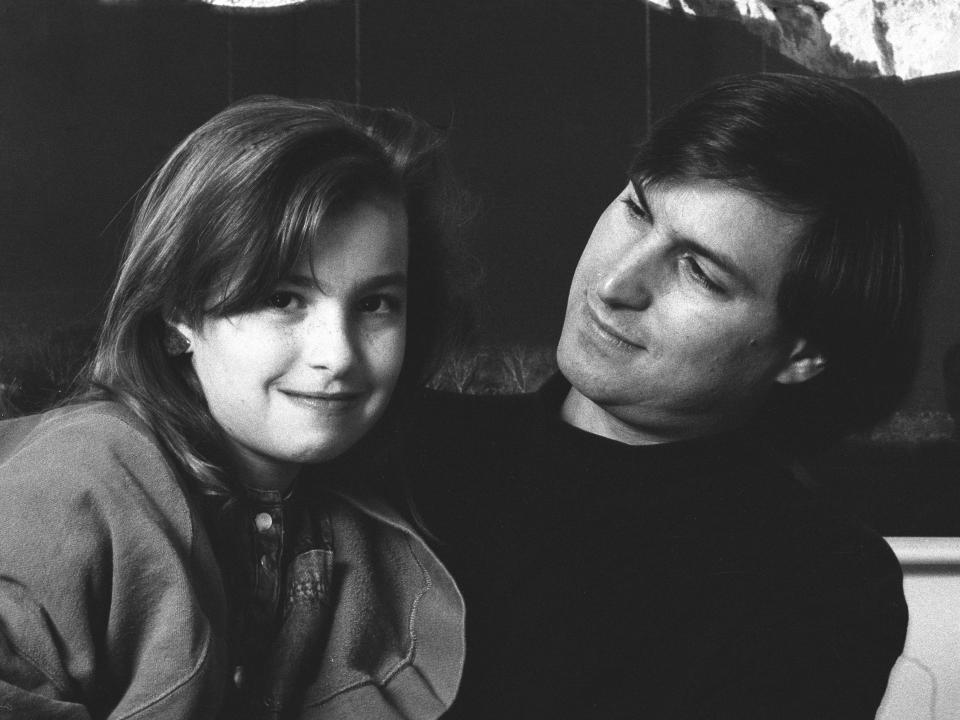
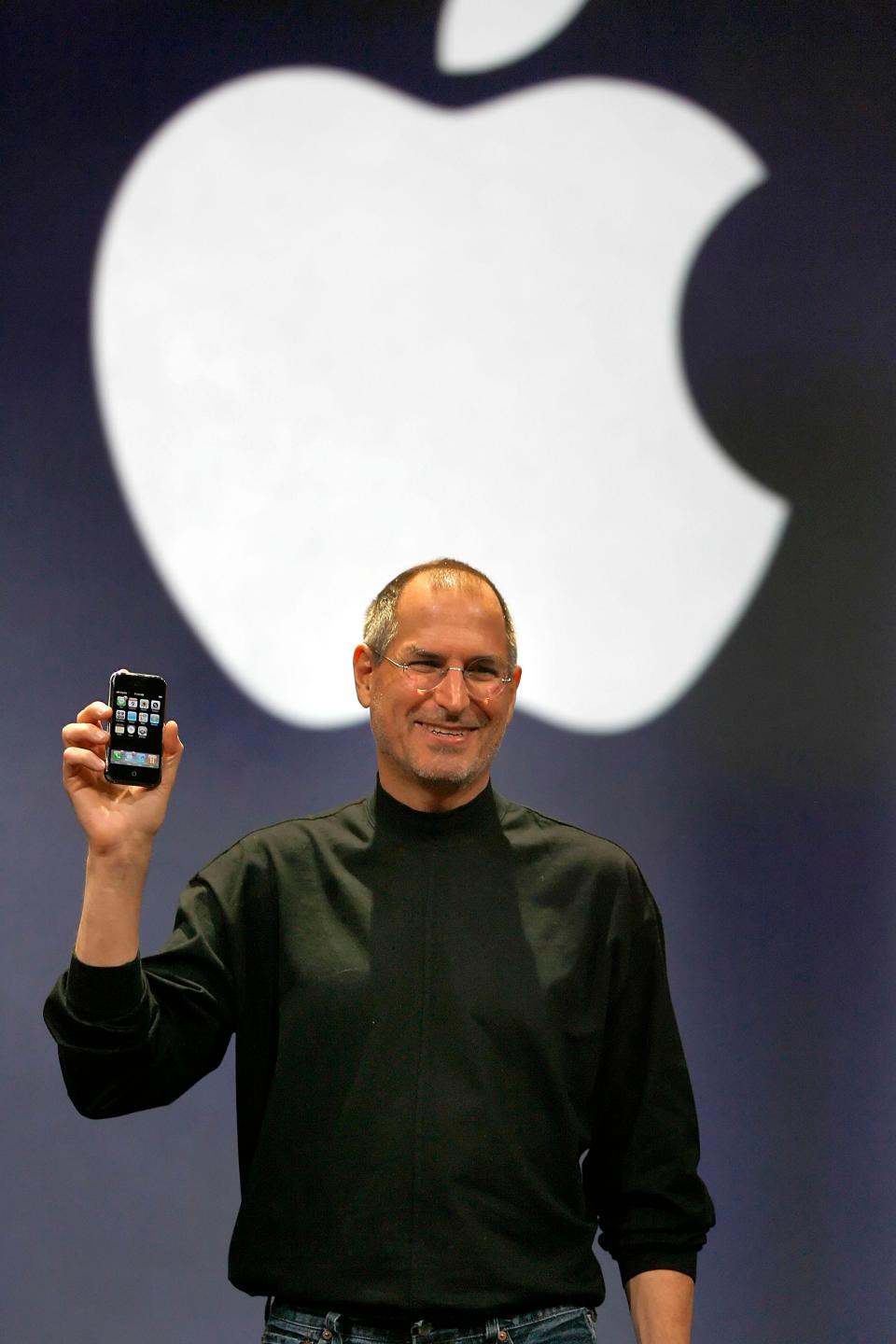
The tumultuous relationship between the late billionaire Apple founder, Steve Jobs, and his daughter, has been analysed.
Apple co-founder Steve Job told his daughter she 'smelled like a toilet' when she visited him on his deathbed
 
Apple co-founder Steve Jobs told his daughter she “smelled like a toilet” when she visited him on his deathbed, she writes in a new memoir about their troubled relationship.
 
Lisa Brennan-Jobs visited her dad about every other month for the year before his death of complications from pancreatic cancer in 2011, she said in her memoir “Small Fry” in Vanity Fair’s September issue.
 
On one such visit, when her dad was so sick he could barely get out of bed, she sprayed herself with expensive rose facial mist she’d found in his bathroom before going to say good-bye.
 
“When we hugged, I could feel his vertebrae, his ribs. He smelled musty, like medicine sweat,” she wrote.
 
Brennan-Jobs, now 40, turned to leave and that’s when her dad called out, “Lis?”
 
“Yeah?” she asked.
 
“You smell like a toilet,” she recalls him saying.
 
Lisa Brennan-Jobs has opened up about her relationship with her late father in her memoir
 
By that point Brennan-Jobs writes she’d already given up on “the possibility of a grand reconciliation, the kind in the movies” with her famous father, who died at 56.
 
Her mom, Chrisann Brennan, had Lisa when both she and Jobs were 23 in 1978 — but he publicly denied he was her father until 1980, when the San Mateo district attorney forced him to take a paternity test and provide child support.
 
The court required Jobs to cover child support of $385 per month, which was then increased to $500 a month — plus back payments — and medical insurance until Brennan-Jobs turned 18. Four days after the case was finalized, Apple went public and Jobs became worth $200 million, his daughter wrote.
 
Even after the case, Brennan-Jobs says her dad was always stingy, aloof and curt with her — even denying that he named one of the first computers he worked on, “The Lisa,” after her.
 
That is until one rare joint vacation, when Brennan-Jobs was 27 and was invited to join a yacht trip with her stepmother, three half-siblings and a babysitter.
 
The family made a stop off the coast of the south of France to Bono’s villa — and the rockstar asked, “So was the Lisa computer named after her?” Brennan-Jobs writes.
 
“My father hesitated, looked down at his plate for a long moment, and then back at Bono. ‘Yeah, it was,’ he said.
 
“I studied my father’s face. What had changed? Why had he admitted it now, after all these years? Of course it was named after me, I thought then. His lie seemed preposterous now. I felt a new power that pulled my chest up,” she wrote.
 
Steve Jobs publicly denied he was her father until 1980
 
She thanked Bono for asking.
 
“’That’s the first time he’s said yes,”’I told Bono,” she recalled. “’Thank you for asking.’ As if famous people needed other famous people around to release their secrets.”
 
In another heartbreaking memory, Brennan-Jobs recalls hearing a rumor as a child that her dad would buy a new Porsche every time he scratched his.
 
One night when she was in the luxury car with him she asked if she could have it when he was done with it.
 
“I wondered where he put the extras,” she wrote.
 
But he responded with anger.
 
“’Absolutely not,’ he said in such a sour, biting way that I knew I’d made a mistake,” she wrote. ” I wished I could take it back. We pulled up to the house and he turned off the engine. Before I made a move to get out he turned to face me.
 
“‘You’re not getting anything,’ he said. ‘You understand? Nothing. You’re getting nothing.’ Did he mean about the car, something else, bigger? I didn’t know. His voice hurt—sharp, in my chest.”
 
Brennan-Jobs’ memoir will be published on Sept. 4 by Grove Press.
 
***
Source: New York Post

Known for its stylish products, U.S. Tech giant, Apple Inc has made a global history setting a new record for others to follow.
Apple
 
U.S. Tech giant Apple Inc has made world history as the first private company in the world to record a market valuation of $1 trillion and even surpass the milestone.
 
PetroChina owned by the Chinese government briefly broke the $1 trillion barrier in 2007 during its initial public offering, but has since dropped back down.
 
Apple attained its unprecedented feat Thursday following its latest surge after reporting strong quarterly earnings.
 
Shares of Apple briefly hit $207.05 in late-morning trading, before retreating somewhat. The gains came after the iPhone maker reported strong earnings late Tuesday that prompted a two-day rally in the share price.
 
The company’s stock was at $206.85, up 2.7 percent near 1620 GMT. Apple said it currently has 4.83 billion shares outstanding.
 
As with other landmarks — such as the Dow crossing 25,000 for the first time — the Apple record is significant because of its resonance beyond the financial universe.

“The $1 trillion mark is more psychological, and sends a message of growth and size into the market,” said Howard Silverblatt, senior index analyst at S&P Dow Jones Indices.
 
But many financial insiders view the record as a non-event, despite breaching the psychological barrier.

“There’s no real excitement on the trading desk,” said Karl Haeling of LBBW. “It’s one of those things that does not mean anything by itself… it’s more a testimony of the importance of Apple on the market.”
 
The landmark is the latest victory for Apple chief executive Tim Cook, who faced skepticism when he took reins of the iconic technology giant in 2011.
 
He took over after the death of founder Steve Jobs, who was identified with launching many of Apple’s most iconic products, including the iPhone smartphone and the iPad tablet.
 
But Cook has gradually won accolades from investors by pumping out a series of solid financial results and further spreading Apple’s products to China and other foreign markets.
 
On Tuesday, Apple reported that net profit jumped more than 30 percent to $11.5 billion. Revenue in the fiscal third quarter soared 17 percent to $53.3 billion from the same period a year earlier due to sales of pricier iPhones, online services and wearable devices.
 
The record also cements the continued supremacy of US technology companies to the broader market, with other large technology giants Amazon, Google-parent Alphabet, Microsoft and Facebook regularly rounding out the top five in market.
 
-NAN

Young people who put their mobile phone on their right ear during calls are exposed to a decline in their memory capacity, according to a new research by the Swiss Institute of Tropical Health and Public Health.
 
File photo
 
Radiofrequency electromagnetic fields may have adverse effects on the development of memory performance of specific brain regions exposed during mobile phone use. These are the findings of a study involving nearly 700 adolescents in Switzerland.
 
The investigation, led by the Swiss Tropical and Public Health Institute (Swiss TPH), will be published on Monday, 23 July 2018 in the peer-reviewed journal Environmental Health Perspectives.
 
The rapid evolution of information and communication technologies (ICT) goes along with an increase in exposure to radiofrequency electromagnetic fields (RF-EMF) in our daily life. The most relevant exposure source to the brain is the use of a mobile phone close to the head. Several studies have been conducted to identify potential health effects related to RF-EMF, though results have remained inconclusive.
 
The research conducted by scientists at the Swiss Tropical and Public Health Institute (Swiss TPH) looked at the relationship between exposure to RF-EMF from wireless communication devices and memory performance in adolescents.
 
The study follows up a report published in the scientific journal Environment International in 2015 with twice the sample size and more recent information on the absorption of RF-EMF in adolescent brains during different types of wireless communication device use. These are the world’s first epidemiological studies to estimate cumulative RF-EMF brain dose in adolescents.
 
Media usage and brain exposure in young adults
 
The study to be published on 23 July 2018 found that cumulative RF-EMF brain exposure from mobile phone use over one year may have a negative effect on the development of figural memory performance in adolescents, confirming prior results published in 2015.
 
Figural memory is mainly located in the right brain hemisphere and association with RF-EMF was more pronounced in adolescents using the mobile phone on the right side of the head.
“This may suggest that indeed RF-EMF absorbed by the brain is responsible for the observed associations,” said Martin Röösli, Head of Environmental Exposures and Health at Swiss TPH.
 
Other aspects of wireless communication use, such as sending text messages, playing games or browsing the Internet cause only marginal RF-EMF exposure to the brain and were not associated with the development of memory performance.
“A unique feature of this study is the use of objectively collected mobile phone user data from mobile phone operators.” said Röösli. He emphasised that further research is needed to rule out the influence of other factors.
 
“For instance, the study results could have been affected by puberty, which affects both mobile phone use and the participant’s cognitive and behavioural state.”
 
The data gathered from the Health Effects Related to Mobile phone use in adolescentS (HERMES) cohort looked at the relationship between exposure to RF-EMF and development of memory performance of almost 700 adolescents over the course of one year.
 
Participants, aged 12 to 17 years, were recruited from 7th to 9th public school grades in urban and rural areas of Swiss-German speaking Switzerland.
 
Minimising the risk of RF-EMF exposure
 
The potential effect of RF-EMF exposure to the brain is a relatively new field of scientific inquiry. “It is not yet clear how RF-EMF could potentially affect brain processes or how relevant our findings are in the long-term.” said Röösli.
 
“Potential risks to the brain can be minimised by using headphones or the loud speaker while calling, in particular when network quality is low and the mobile phone is functioning at maximum power.”
 
*********
 
Source: ScienceDaily

Social media giant, Twitter Inc, has announced the appointment of Nigeria's former minister of finance, Dr Ngozi Okonjo-Iweala, as a member of its board of directors.
 
Okonjo Iweala
 
Twitter, Inc. have on Thursday, announced the appointments of Ngozi Okonjo-Iweala and Robert Zoellick to Twitter’s Board of Directors (the “Board”) as new independent directors, effective immediately.
 
“Ngozi and Bob are distinguished leaders with unparalleled global perspective and policy expertise,”said Omid Kordestani, Executive Chairman of Twitter.
 
“We are confident they will be incredible assets to Twitter as we continue to focus on driving transparency and making Twitter a safer, healthier place for everyone who uses our service.”
Kordestani added, “On behalf of the Twitter Board, I want to thank Marjorie for her service on the Twitter Board over the past five years. Marjorie joined the Board in 2013 and has been a strong voice on our board as our Lead Independent Director.
 
"Marjorie’s insights and contributions have been invaluable, and all of us at Twitter wish her the best and look forward to her contributions through the end of the year.
“Twitter is a powerful platform that continues to be used as a strong connector for the global community, and I’m thrilled to be a part of the team,” said Dr. Okonjo-Iweala.
“As we strive to build a better world for tomorrow, Twitter can amplify messages and drive critical conversations around today’s most important issues. I look forward to partnering with Twitter’s talented directors and leadership team as we work to leverage the power of Twitter for good.”
“I’m honored to join a company as purposeful as Twitter,” added Mr. Zoellick. “Twitter has made meaningful progress in expanding and encouraging global dialogue and creativity on its platform, and I’m privileged to work with Jack, Omid and the rest of the Board to continue the strong momentum underway.”
 
Additional details regarding the appointments can be found in a Form 8-K filed by Twitter with the Securities and Exchange Commission.

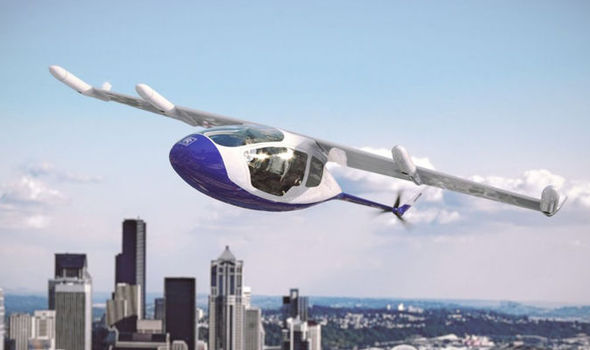
Two years from now, Rolls-Royce will roll out its hybrid electric 'flying taxi' to make air transportation easier.
Rolls-Royce flying taxi
 
British engine maker Rolls-Royce revealed plans this week to develop a hybrid electric vehicle, dubbed the “flying taxi”, which takes off and lands vertically and could be airborne within five years.
 
The London-listed aerospace giant, which is based in Derby in central England, showed off the plans at the Farnborough Airshow for the first time, as other players also rush into the market segment.
 
Rolls said it hoped to manufacture a prototype version of its electric vertical take-off and landing (EVTOL) vehicle within the next 18 months, and could potentially take to the skies in the early 2020s.
 
The Rolls-Royce EVTOL plane will seat four or five people, with a flying range of 500 miles (805 kilometres) and a top speed of 200 miles per hour.

“In this market, you will see something like this flying within three to five years, and we will demonstrate the system in two years,” said Rob Watson, head of Rolls-Royce’s electrical team.

“At the end of next year we will be flight ready,” he told AFP at the group’s Farnborough chalet.
 
The hybrid vehicle, which has so far cost single-digit millions of pounds to develop, will use a traditional gas turbine engine with an electrical system wrapped around it.
 
Rolls-Royce is also researching an all-electric product but that is not as advanced as the EVTOL offering.

“There is an emerging market for all-electric planes but we believe that you need a level of requirement that an all electric system cannot really provide today,” Watson told AFP.
 
“So, all-electric is the way to hop around within a city, but if you want to travel 200 or 300 miles, if you want to run London to Paris, then you are going to want to run something that will give you that range.

“So we think you will see hybrid propulsion systems starting to make this market.”
 
Rolls-Royce is not alone in the hybrid “flying taxi” marketplace.
 
Other companies researching the sector include US taxi-hailing company Uber, the Google-backed Kitty Hawk project, Lilium Aviation in Germany, Safran in France, and Honeywell in the United States.
 
-NAN

College students have achieved a laudable feat after they managed to develop a cheap obstacle detector to held the blind.
File photo: A blind person
 
The News Agency of Nigeria has reported that students from China’s Nanjing University of Aeronautics and Astronautics have developed an obstacle detector for the blind with much lower cost.

According to the report, the initial cost of the obstacle detector is 30 yuan (about 4.5 dollars).

Domestic enterprises currently manufacture devices for visual impairments, equipped with cameras, however, such devices range from 3,000 to 8,000 yuan.

The detector composed of a single chip and two ultrasonic sensors which can distinguish and measure obstacles and roadblocks in front of it.

By holding the device in the palm of their hand, blind people can traverse the road more easily as the device will make a sound when there are obstacles ahead.

“The alarm rings once when a person comes within one meter of an obstacle.

“The alarm rings twice when the person is within 60 cm, three times at 30 cm,”
 Developer Ma Wang was quoted as saying.

The detector has not been industrialised.

Ma Wang said his team would make it more portable and stable as well as smaller and more accurate at detecting objects.

Nigerians are very innovative despite the stifling conditions that mitigate against success and individual progress in the country.
 
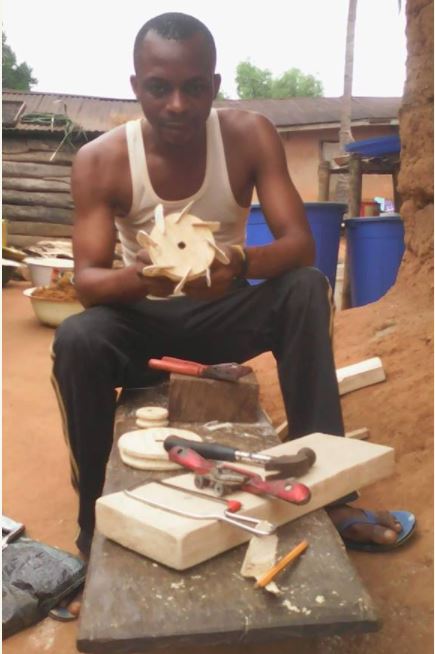
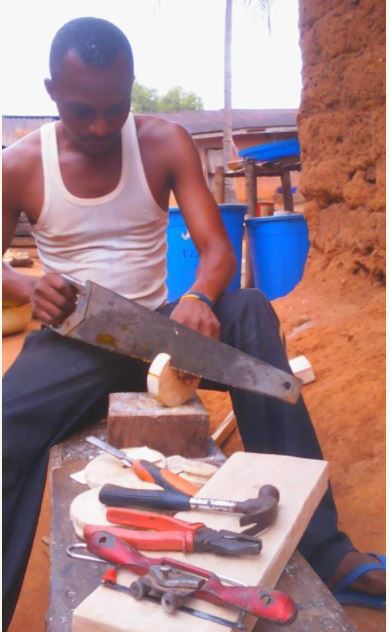
Augustine Otuokwa Ogar working on his invention
 
The 32-year-old man identified as Augustine Otuokwa Ogar, who became an online sensation after constructing a 200 Mega Watts mini Hydroelectric power plant that generates electricity for the plant site and its surrounding early this year, is back again with another cool invention.
 
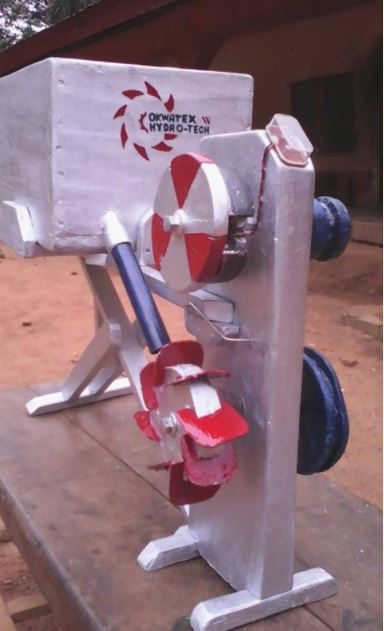
The graduate of Electronic and Computer Technology, University of Calabar (UNICAL), who comes from Wula village, Eastern Boki in Boki Local Government Area of Cross River State, has constructed a Hydroelectric power machine that uses a bucket of water to run using locally sourced materials.


The talented man explained his research on Hydroelectricity to Calabar Reporters as he revealed that the system generate up to 20 watts (20W) of power that powers the injector pump and some phones and it operates when the top tank is filled with a bucket of water.
 
He said, “The device has two wooden tank (the up and down tank) for collection of water, a pen stock to control water out of the upper tank to the turbine, the turbine that convert the potential energy of water into mechanical energy that rotate the alternator through the pulley system, the alternator that generates power and lastly a riding machine injector pump motor which pump back water from the down tank to the upper tank and the process continues”.
 
 
Explaining how it works, Ogar said, “A bucket of water if emptied in the tank and water is allowed to flow and hit, turn the turbine which rotate the alternator, then electricity is generated which then energizes a small pumping machine that pump back the water into the first tank then process continues. The system carries two tanks, up and down tank. I decided not to show everything here for technical reasons

“It operates without a repulsive force or zero back electromotive force (emf). I invented it to be used for practical demonstration on hydroelectricity. It generates up to 20 watt during operation but I stepped down the power to power one blinking LED for demonstration and technical reasons.

“The system generate up to 20 watt of power that Powers the injector pump and some phones and it operates when the top tank is filled with a bucket of water and it’s a continues system. Although, not every part of the system is shown here for technical reasons because it’s going to be a huge technology in the nearest future.

“It shouldn’t be a surprise to any one that water contains both potential and kinetic energy and the law energy that it can be converted from one form to the other. On like mechanical generators, this device has two major sections also, the turbine that does the conversion of the potential energy of the River into motion serves as the mechanical part of the device while the alternator which convert this mechanical energy into electricity, is the electrical part of the device.

“The river that carries both the kinetic and potential energy is the fuel or the power house of the device. This is an era of renewable energy, can we join hands together to really developed this local innovation to solve the problem of power outage in Rural and Urban areas? And also to combat the challenges of global warming? What about training of youths on hydroelectricity by establishing renewable energy? Building training centers across the country and also creating job opportunities. God bless Nigeria”, Ogar concluded.

Forbes magazine has interviewed a young Nigerian entrepreneur who has successfully built a digital education technology company that is currently worth $3million. His story will motivate and inspire you.
 
Temitope Ogunsemo
 
33-year-old Nigerian-born Temitope Ogunsemo, is the founder of Krystal Digital, a fast-growing educational technology company that specializes in the creation, development and deployment of customized and service oriented software applications for educational institutions in Nigeria.
 
Founded in 2010 in Lagos, Krystal Digital’s flagship service, MySkool Portal, a web-based application for School Information Management System designed for proper storage and documentation of school data, has been adopted by more than 50 Government-owned High schools in Nigeria, and has more than 65,000 active student users.
 
Krystal Digital now has more than 150 employees and annual revenues of more than $3 million.
 
While speaking in an exclusive interview with Forbes in Lagos, Temitope recounted his early beginnings, mused on the journey so far, and talked about Krystal Digital’s plans for the future.
 
Here are excerpts;
 
What’s your educational and professional background?
 
I am an alumnus of Kings College, Lagos. I attended the prestigious University of Ibadan and also went ahead to obtain a Master of Science degree in Information Management Systems from the University of Salford, UK. In 2010, I answered my lifelong call of entrepreneurship when I and a group of consultants founded Krystal Digital. Today, Krystal Digital is one of the leading IT Companies in Nigeria.
 
What is Krystal Digital? What would be an elevator pitch for someone who does not know about your company and your services?
 
Krystal Digital is a fast growing ICT company which specializes in the development and deployment of customized and service oriented software applications as well as IT training. The Company is focused on strengthening the application of ICT in the Education sector, especially the Basic and Secondary Education Sub-sector.
 
Krystal Digital is popular for its MySkool Portal, your flagship School Information Management System for secondary schools in Nigeria. What was the opportunity?
 
The idea that would spawn Krystal Digital was initiated when I attempted to secure my academic transcript. It was a difficult and frustrating experience. It was then I saw potential to develop a School Information Management System that would not only improve the storage/preservation and retrieval of academic records but would also position these schools to harness the benefits of digitization.
 
How many schools in Nigeria today are utilizing your MySkool portal? Give us a profile of your clients?
 
Our products and services currently span across 48% of the Federal Government Colleges in Nigeria. The MySkool Portal Platform runs in fifty Federal Government Colleges across the federation. Most of the Directors at Krystal Digital are products of Unity colleges and we were availed high-quality education and orientation. This played an important role in grooming us into what we are today. Unfortunately, some of these virtues are fast disappearing and it became imperative for us to ensure that technology became an intrinsic part in the education management system in Federal Unity colleges. This is probably one of the reasons why our focus at the moment is on Federal Government Colleges.
 
Walk us through Krystal Digital’s business model. How do you make money to keep the lights on, and where do revenues stand today?
 
Our aspiration is to drive growth in the Education sector by building a leading sub-Saharan IT organization. In delivering quality services we have modeled the structure of our business to ensure it is aligned with the needs of our clients and how they would rather be served. Our business model has three inputs: Our people, Our operations and Innovation. Our intellectual capital is critical to provide innovative solutions. We rely on the ability of our people to innovate and collaborate with each other and our customers to develop value-adding solutions. We are also committed to conducting our business transparently and ethically by managing our business process towards ensuring a positive impact on the society.
 
The organization no longer relies on the Myskool Portal solution as its main source of revenue as Krystal seeks to augment its financial structure by championing the Krystal/Microsoft Imagine Academy. Notwithstanding we have achieved strong revenue growth in what continues to be a complex business environment. We have annual revenues of more than one billion naira - roughly three million dollars.
 

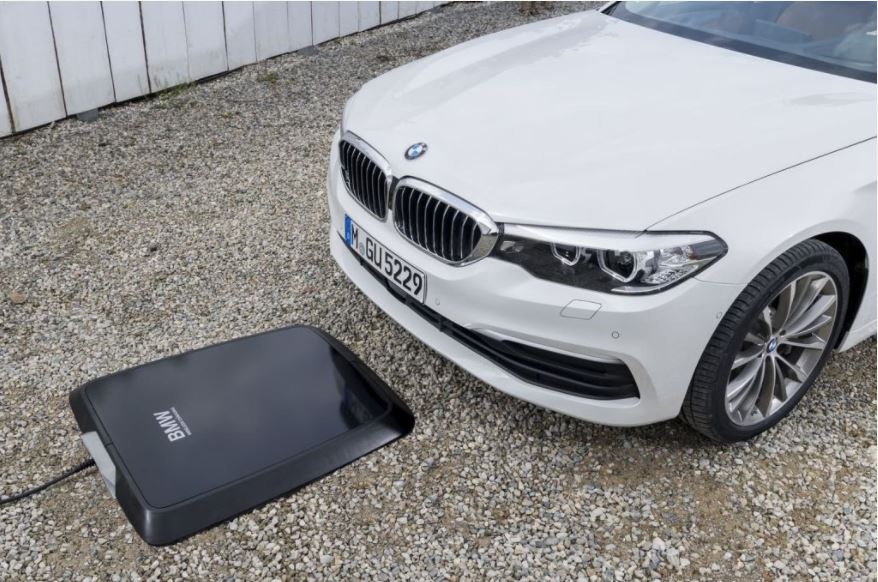
BMW which is a German multinational company which currently produces automobiles and motorcycles, and also produced aircraft engines until 1945 has developed a special form of charging phones.
 
The vehicle and the charging pad
 
BMW is the first automaker to offer wireless vehicle charging from the factory on a model.
 
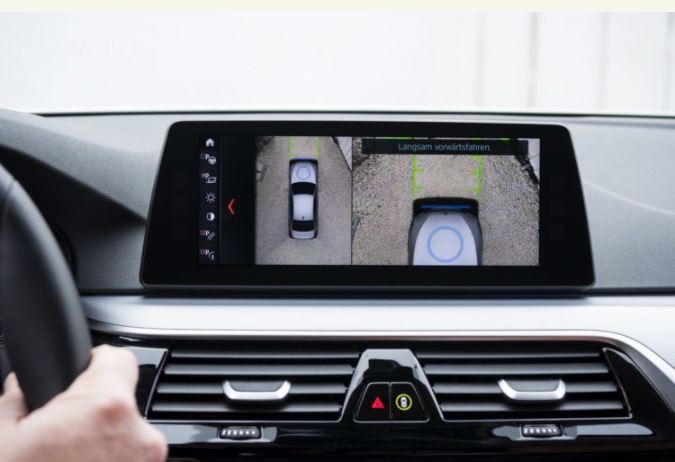
This short clip explains how “BMW Wireless Charging”, the technology that allows energy transfer to take place without the use of cables.


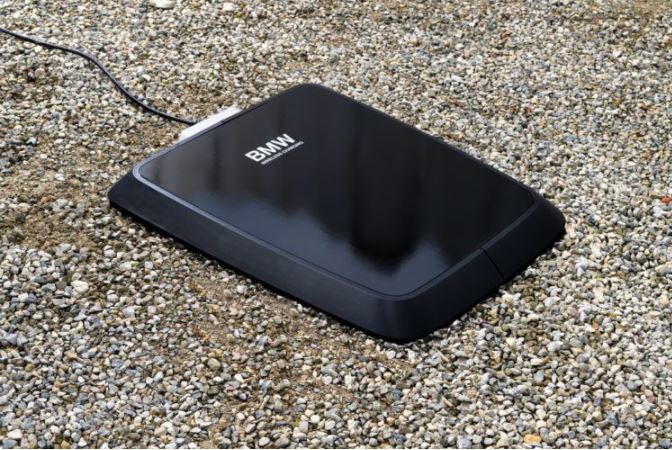
The system consists of a base pad with integrated primary coil ,which can be installed in a garage and outdoors,and a secondary coil integrated in the underside of the vehicle.
 
An alternating magnetic field is generated between the two coils, through which electricity is transmitted without cables or contacts at a charge rate of up to 3.2 kW.
 
This form of power supply to the high-voltage battery is extremely convenient for customers and involves a charging time of around three-and-a-half hours.
 
Wireless charging for the high-voltage battery will be made available as an option for the BMW 530e iPerformance plug-in hybrid starting this year.
 
Watch a video of the initiative below:


The number of Nigerians using mobile phones and other handy devices to access the internet has continued to increase impressively.
 
File Photo
Internet users in the country increase to 100. 9 million in February from 1.2 million in January, the Nigerian Communications Commission (NCC), has said.
It was gathered that, The NCC made this disclosure in its Monthly Internet Subscribers Data for February 2018 on its website on Monday in Abuja.
The data showed a marginal increase of 670,385 new subscribers in the country.
NCC said Airtel, MTN gained more internet subscribers during the month in review, while Glo and 9mobile were the big losers.
The breakdown revealed that MTN gained the most with over 762,366 new internet users increasing its subscription in January to almost 38 million from 37 million recorded in January.
It said Airtel also gained 247.216 new internet users in February amounting to 25,075,110 million users as against 24,827,894 users in January.
It said 9mobile however lost 146,034 internet users in February, decreasing its subscription to 11,132,153 as against 11,278,187 recorded in January.
The data showed in February that Globacom lost 193,127 internet users decreasing its subscription 26,733,989 from the 26,927,116 recorded in January.

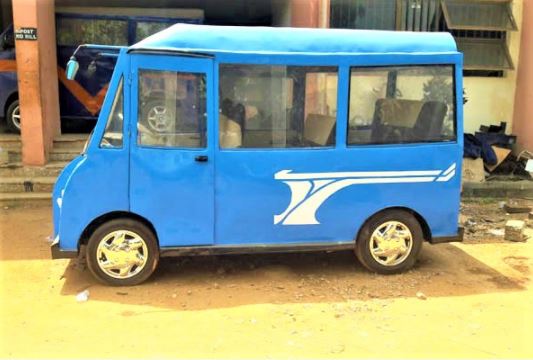
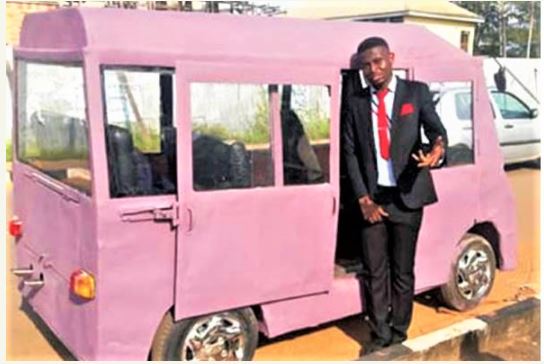
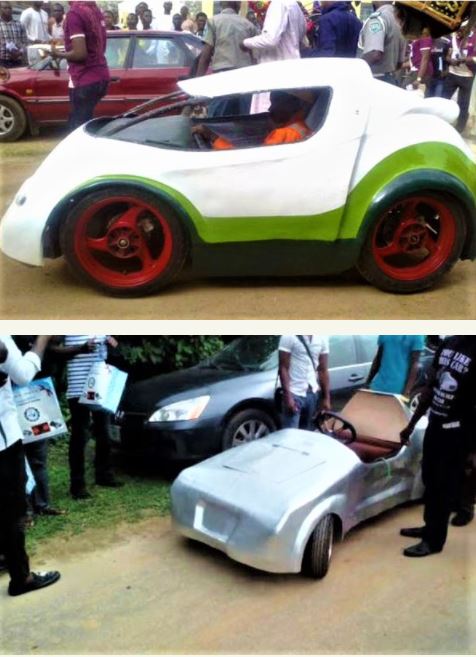
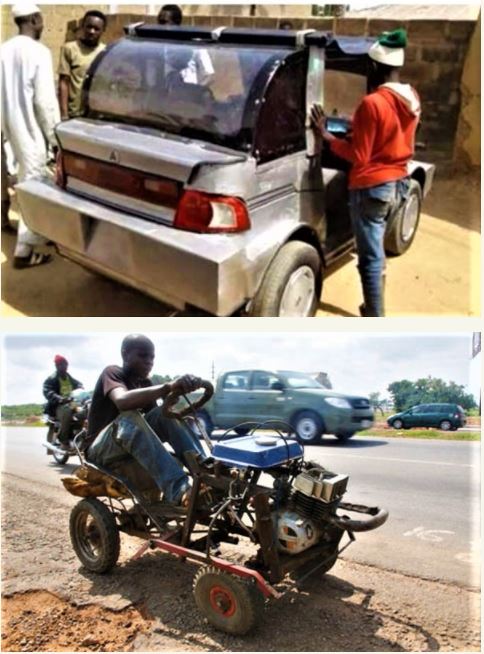
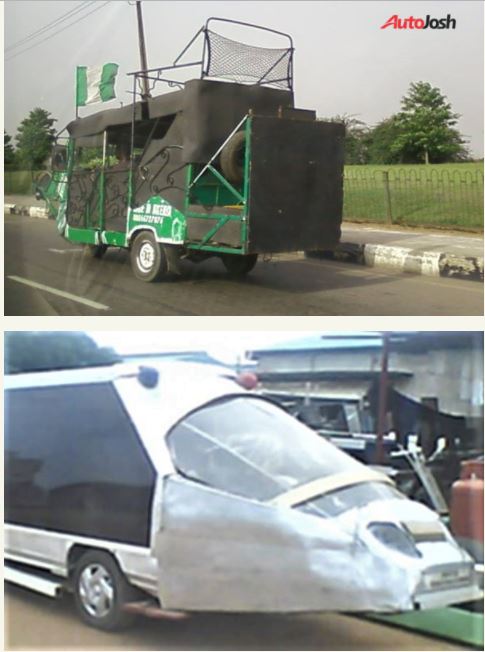
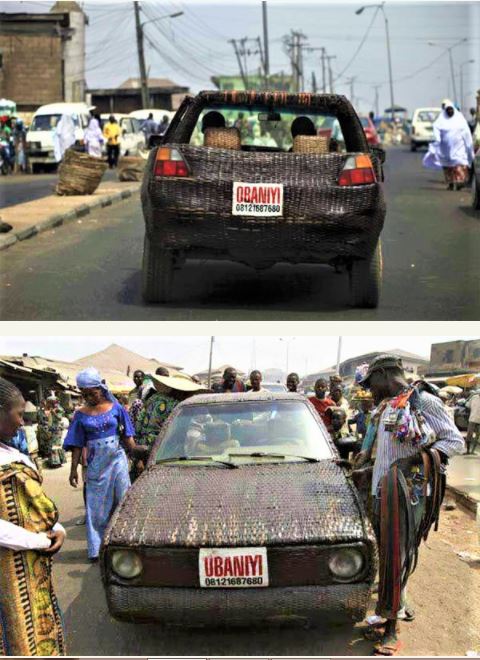
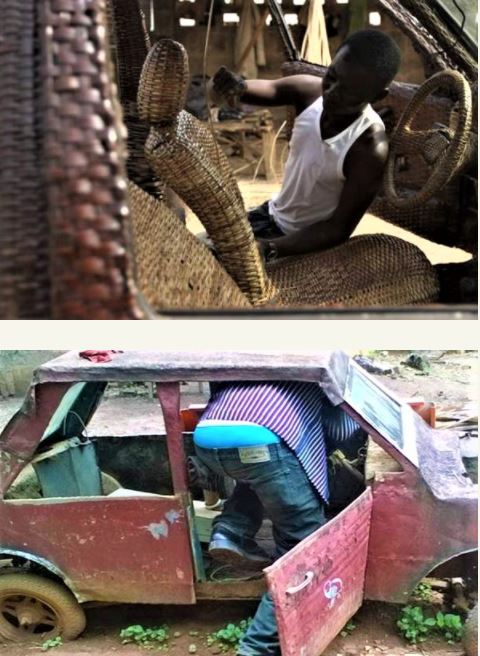
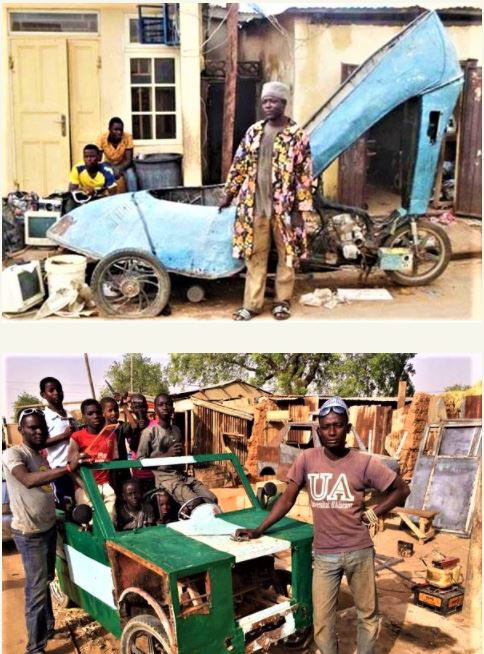
Contrary to wide insinuations, Innoson Vehicle Manufacturing Company is not the first and only indigenous producer in the country, other persons and groups are also in the business.
 
One of the crudely made vehicles
 
The land is replete with Nigerians who have also ventured into the business of producing automobiles – or, as in some cases, contraptions that resemble vehicles. 
 
The products of these Nigerian “automakers” might not exactly have the finesse or the aesthetic attraction of an Innoson brand of vehicle – neither do they have the elaborate factory setup like Innoson Vehicle Manufacturing Company. However, their drive to fabricate something out of something should count for something.
 
Anyway, Autojosh presents some “vehicles” produced by some determined and some rather ambitious Nigerians.
 
Meanwhile, Nigerians have been making jokes out of the pictures of the locally-made vehicles on this post.
 
See more photos:


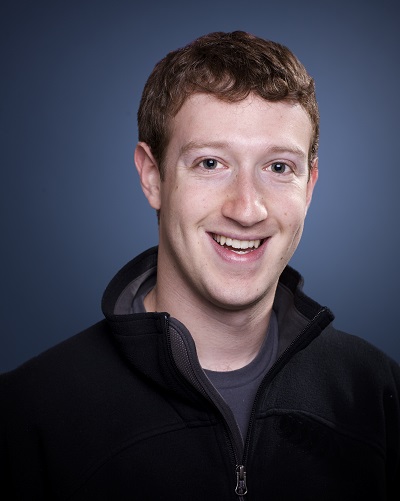
Mark Zuckerberg has been under fire recently following the Cambridge Analytica scandal but this hasn't deterred him from criticizing the producers of iPhone.
 
Mark Zuckerberg
 
Facebook CEO Mark Zuckerberg remained silent for far too long following the revelation that a shady political consultancy firm called Cambridge Analytica was able to steal personal data belonging to an estimated 50 million people using Facebook’s own tools. Now that Zuckerberg has broken his silence, however, he can’t stop talking.
 
The Facebook co-founder and chief executive issued an initial statement nearly two weeks ago, and he has since apologized in a full-page newspaper ad as well as in several interviews. Of course, we’ve all been down this road many times before. Facebook screws up, Zuckerberg apologizes, Facebook makes a few changes to privacy controls, and the commotion slowly fades away until the next big privacy scandal pops up. Lather, rinse, repeat.
 
The Cambridge Analytica scandal is a big one, though. It is perhaps one of the biggest privacy scandals in Facebook’s history, which is long and full of privacy scandals.
 
Using Facebook’s developer tools, the company was able to harvest private data belonging to more than 50 million Facebook users by circulating a fake “personality quiz” that was completed by only a few hundred thousand users. Facebook has been the target of a great deal of criticism since a whistleblower brought this scandal to light, and now Mark Zuckerberg has responded to one of Facebook’s highest-profile critics: Apple CEO Tim Cook.
 
Apple’s Tim Cook is the CEO of the biggest publicly traded company in the United States, and he used the Facebook/Cambridge Analytica scandal as an opportunity to remind the world that Apple values its customers’ privacy. While companies like Facebook and Google make money by learning as much as possible about users to serve them targeted advertisements, Apple makes money by overcharging for cell phones.
 
Both strategies have pros and cons, but the latter prevents Apple from having to deal with the blowback from privacy scandals akin to Facebook’s current predicament.
 
In an interview on MSNBC with host Chris Hayes last week, Cook had a lot to say about Facebook and its most recent privacy scandal. When Hayes asked the CEO what he would do if he ever found himself in Zuckerberg’s current situation, he offered a great response: “I wouldn’t be in this situation.”
 
As we all know, the user is the product with free services like Google’s search engine or Facebook’s social network. Google and Facebook are advertising companies. Cook reiterated that Apple doesn’t collect data and sell ads the way Facebook does, so the customer is not the product.
 
“[Apple could] make a ton of money if we monetized our customer,” Cook told Hayes during the interview. “We’ve elected not to do that.”
 
Cook continued, “I think it’s an invasion of privacy. I think it’s – privacy to us is a human right. It’s a civil liberty, and in something that is unique to America, this is like freedom of speech and freedom of the press and privacy is right up there for us. And so, we’ve always done this. This is not something that we just started last week when we saw something happening. We’ve been doing this for years.”
 
Well, it’s been almost a week since that interview, and now Facebook CEO Mark Zuckerberg has finally issued a public response. In an interview on a podcast with Vox co-founder Ezra Klein, Zuckerberg called Cook’s remarks “extremely glib and not aligned with the truth.” He went even further, suggesting that Cook was quick to tear apart Facebook’s business model when his company’s own model isn’t very consumer friendly.
 
“I think it’s important that we don’t all get Stockholm Syndrome and let the companies that work hard to charge you more convince you that they actually care more about you,” Zuckerberg said. “Because that sounds ridiculous to me.”
 
Zuckerberg went on to explain that Facebook is one of several ad-supported online products, claiming that its goal is to connect everyone, even those who cannot afford to pay for such a service.“The reality here is that if you want to build a service that helps connect everyone in the world, then there are a lot of people can’t afford to pay,” he said.
 
“And therefore, as with a lot of media, having an advertising-supported model is the only rational model that can support building this service to reach people.”

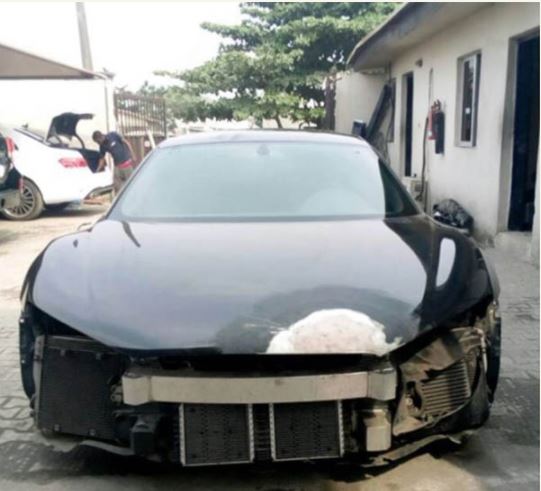
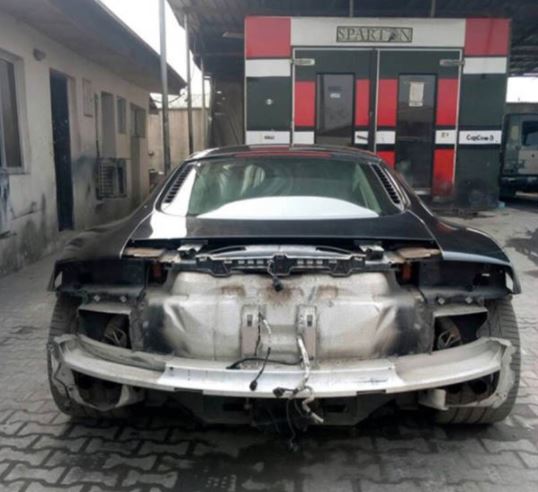
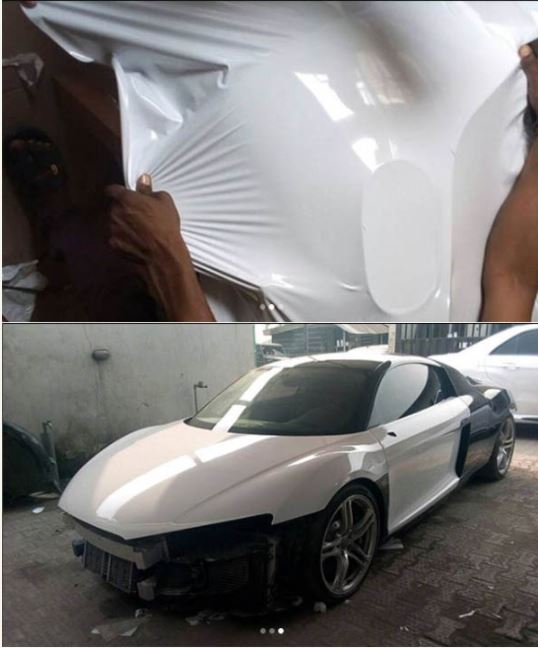
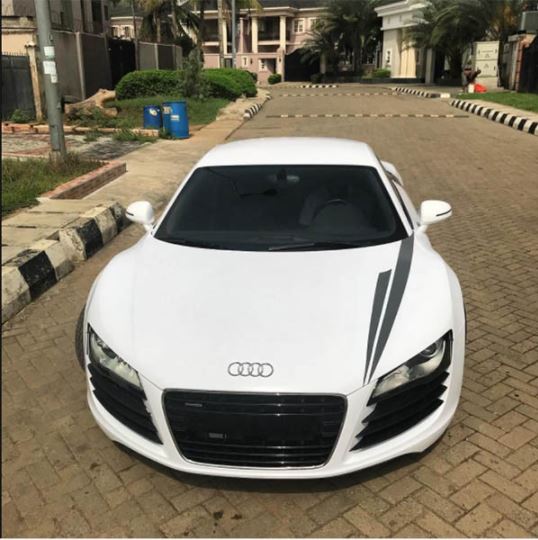
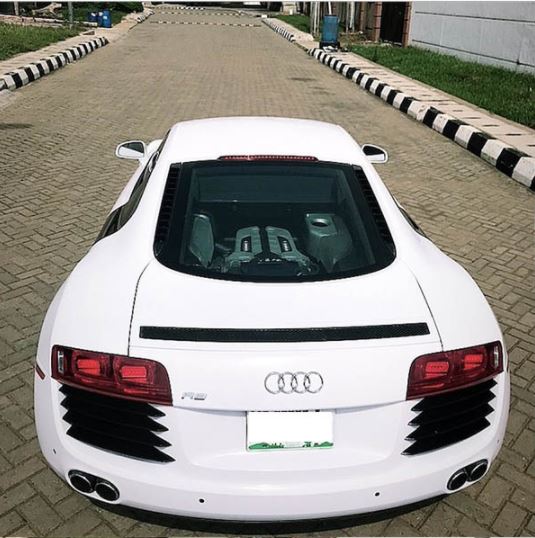
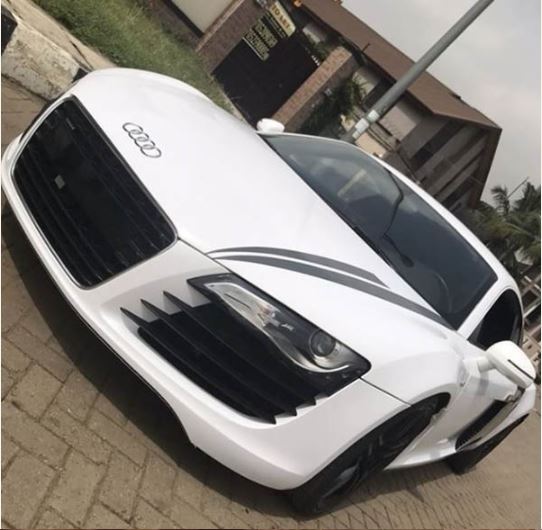
An accidented Audi R8 was recently pimped up in Nigeria by skilled professionals who transformed it to its initial form as it left the factory.
 
The accidented  Audi R8
 
The Audi R8 as you can see above was lined up for refurbishing with Nigerians showing the world we are not lacking in human resources.
 
The pictures here indicate how the body of the mangled exotic car was chronologically fix and cruised around on the street as it its brand new.

The Audi R8[2] (Typ 42)  is a mid-engine, 2-seater sports car, which uses Audi's trademark quattro permanent all-wheel drive system. It was introduced by the German car manufacturer Audi AG in 2006.
 
The car is exclusively designed, developed, and manufactured by Audi AG's high performance private subsidiary company, Audi Sport GmbH (formerly quattro GmbH), and is based on the Lamborghini Gallardo platform.
 
The fundamental construction of the R8 is based on the Audi Space Frame, and uses an aluminium monocoque which is built using space frame principles. The car is built by quattro GmbH in a newly renovated factory at Audi's 'aluminium site' at Neckarsulm in Germany.
 
See more photos of the refurbishing process below:


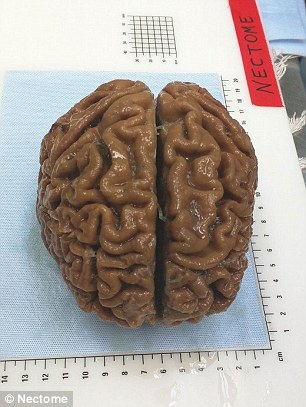
A United States' Silicon Valley billionaire, has paid $10,000 to be killed in a suicidal way so the contents of his brain can be digitally uploaded and preserved forever in a computer.
 
Sam Altman
 
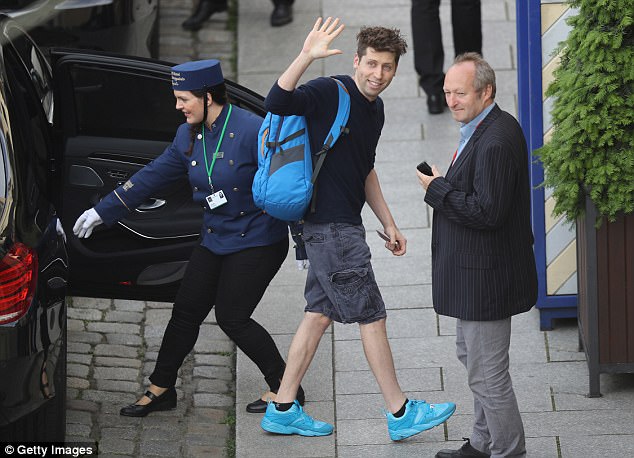
A 32-year-old Silicone Valley tech-billionaire, Sam Altman, is paying $10,000 to be killed so his brain can be digitally preserved forever in a computer.
 
According to a report by Dailymail UK, the entrepreneur is one of 25 people on a waiting list at Nectome, a startup company that says they can upload the contents of a person's brain and store it on a computer.
 
But in exchange for eternally preserving his mind, Sam will have to die in a process similar to physician-assisted suicide which is only legal in five US states.
 
 
Somewhat ironically, the company Sam founded, Y Combinator, funds startups like Nectome.
 
The process he's signed up for involves embalming the brain so it can later be simulated onto a computer, according to the MIT Technology Review.
 
The customer, alive, is hooked up to a machine and then injected with Nectome's embalming chemicals. The company said the method is '100 percent fatal.'
 
'The user experience will be identical to physician assisted suicide,' Nectome's co-founder Robert McIntyre told the Review.
 
 
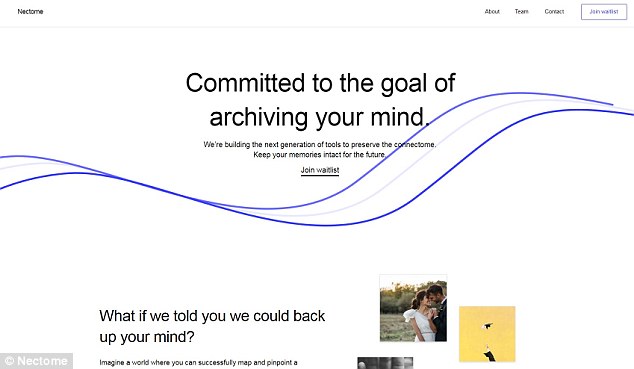
On the company's website, it says the mission is to'preserve your brain well enough to keep all its memories intact: from that great chapter of your favorite book to the feeling of cold winter air, baking an apple pie, or having dinner with your friends and family.
 
'We believe that within the current century it will be feasible to digitize this information and use it to recreate your consciousness.'
 
The business pitch, similarly, said: 'What if we told you we could back up your mind?'
 
Embalming fluid can keep a body frozen and intact, without the threat of it starting to decompose, for hundreds or potentially thousands of years. But in order for the procedure to work, the brain has to be fresh, according to the Review.
 
 
Nectome said it plans to connect people with a terminal illness who sign up to a heart and lung machine and pump the embalming mixture into their cateroid arteries in their necks while they are alive but under general anesthesia.
 
The practice does qualify as physician-assisted suicide, which is currently only legal in five out of the 50 states. And even in those states, an individual must have a terminal illness and have been told they will only live for six months or less.
 
The company has consulted lawyers familiar with the law, and said that if people have a terminal illness they believe this service will be legal to them.
 

MARI themes

Copyright JUSTDOIT9JA © 2017 - 2021. All Rights Reserved. Powered by Blogger.